Epson vs Brother Ink Tank Printers: Which to Choose? (November 2026)
Buy the Epson EcoTank ET-2900 for most homes: it prints 11 black pages a minute, scans on a flatbed and ships with ink for up to 3 years. Pick Brother's INKvestment Tank MFC-J4335DW instead when you need automatic duplex printing and a document feeder.
On this page (12 sections)
- Epson vs Brother ink tank printer: which is better for most homes?
- The quick verdict at a glance
- Print speed and daily output
- Ink systems and refills
- Scan, copy and document handling
- Paper handling and two-sided printing
- Running costs and ink life
- Setup, size and placement
- Who should choose the Epson ET-2900?
- Who should choose the Epson ET-2800?
- Who should choose the Brother MFC-J4335DW?
- Final verdict: epson vs brother ink tank printer
Buy the Epson EcoTank ET-2900 for most homes, because it prints 11 black pages a minute, scans on a flatbed and ships with ink for up to 3 years. The Brother INKvestment Tank MFC-J4335DW is the better pick when you print lots of two-sided documents and need a sheet feeder.
An epson vs brother ink tank printer comparison usually starts with ink cost, but both brands solve that problem. The real gap is in speed, paper handling and the functions built into the box.
The three printers below cover both approaches: Epson's refillable EcoTank tanks and Brother's internal ink tank fed by cartridges. You'll see which suits a home desk, a homework corner and a small office.
 Best overall
Epson EcoTank ET-2900 Wireless All-in-One Color Supertank
Epson vs Brother ink tank printer: which is better for most homes?
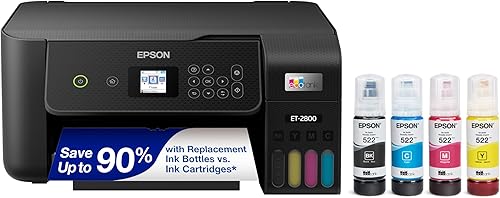
The Epson ET-2900 is the best overall choice for most households. It has the highest score of the three picks and the widest set of everyday features for a family printer.
Its 11 black and 6 color ISO ppm speeds and zero warmup time mean a homework page appears fast. The 1.44-inch color display makes menu changes simple without reaching for a phone.
Epson says the unit ships with enough ink to last up to 3 years and rates the bottle set for 3,600 black and 6,500 color pages. A replacement set is equivalent to about 80 cartridges.
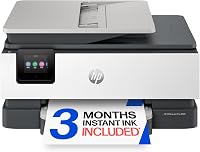
Brother's MFC-J4335DW scores 7.3. It leans toward office work with 20 black and 16 color ppm printing, duplex output and fax.
That's a narrower fit for a home with kids and photos.
If you're still weighing brands beyond these two, our HP vs Epson printer breakdown covers how HP's cartridge models compare on cost and features.
The quick verdict at a glance
Pick the ET-2900 unless duplex printing or a document feeder is a must. Everything else in this comparison is a trade-off between convenience and office functions.
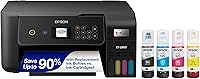
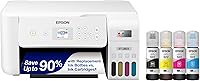
The ET-2900 is the winner for general home printing, scanning school papers and running a shared wireless printer. The ET-2800 is the budget-friendly EcoTank if the ET-2900 is more than you need.
Brother's MFC-J4335DW is the winner for two-sided forms, long scans and anyone who wants fax on the same machine. It's the pick for a home office with paperwork, not for a living room desk.
Here's a summary of the three options:
| Printer | Score | Best for | Black speed | Duplex |
|---|---|---|---|---|
| Epson EcoTank ET-2900 | 9.7 | Best overall | 11 ppm | Simplex |
| Epson EcoTank ET-2800 | 8.4 | Light family printing | 10 ppm | Simplex |
| Brother MFC-J4335DW | 7.3 | Duplex office jobs | 20 ppm | Automatic |
Speed figures are ISO pages per minute from each brand. One number rarely decides the purchase, but it sets expectations for busy weeks.
Print speed and daily output
Brother prints documents faster, while Epson gives you cartridge-free refilling and a flatbed scanner. Speed matters when you print dozens of pages at once, not for a few sheets a day.
The Brother MFC-J4335DW reaches 20 black and 16 color ppm. The ET-2900 manages 11 black and 6 color ppm, and the ET-2800 is close behind at 10 black and 5 color.
For a household printing school forms, recipes and the odd photo, Epson's pace is plenty. A 20-page report takes a while on any of these, but it isn't a reason to switch unless you print daily.
Epson's Heat-Free printhead design with no warmup time helps the ET-2900 start quickly. Brother's speed advantage shows up over longer runs, especially with duplex enabled.
If you run a busy home office, weight the Brother's pace heavily. For most family printing, the Epson is the better balance.
Ink systems and refills
Both brands cut ink costs, but they do it differently: Epson uses refillable tanks, Brother uses front-loading cartridges into an internal tank. Neither needs you to hunt for a store each month.
The ET-2900 uses EcoFit bottles with keyed shapes. Each color bottle only fits its own tank, so you can't mix cyan into the black tank.
Epson says refilling needs no mess and no stress.
The ET-2800 uses the same refillable tank idea with bottles rated for 4,500 black and 7,500 color pages. Epson recommends genuine ink bottles to keep print quality and the warranty intact.
Brother's INKvestment Tank system keeps an internal tank topped up from front-loading cartridges. There are no bottles to pour, which some people prefer.
Brother says the box includes up to 1 year of ink.
Start with the right ink from day one, then follow our guide to maintaining an ink tank printer so the printhead stays clean between jobs.
How Epson's EcoTank ink works
Epson invented the EcoTank line and says it has sold 100 million units worldwide across seven generations. The ET-2900 is the 7th generation of cartridge-free printers.
The box includes one bottle of 522 Black and one bottle each of 522 Cyan, Magenta and Yellow, all 65 mL. That's enough to get through plenty of homework before a refill.
Epson's 522 ink is the compatible bottle type for the ET-2900. Check the bottle label when you restock.
How Brother's INKvestment Tank works
Brother reengineered its cartridges to feed an internal tank, so the ink flows continuously without you pouring anything. The starter cartridges are black, cyan, magenta and yellow.
The system is simpler for people who dislike ink bottles. It also means you're buying cartridges again, though at longer intervals than standard cartridge printers.
Alexa connectivity adds ink level alerts and optional reordering. That's a practical extra if you use smart speakers already.
Scan, copy and document handling
Epson's flatbed scanner handles single pages and books; Brother adds a 20-page document feeder for stacks. The feeder is the feature that tips small offices toward Brother.
Both Epson models include a flatbed scanner and copier. The ET-2900 tops out at 99 copies per run and captures color input at 48-bit depth, which helps with photos and art.
The ET-2800 also scans on a flatbed, so single documents and photos are easy on either Epson. Copy resolution runs up to 300 x 600 dpi black and 720 x 720 dpi color.
Brother's 20-page automatic document feeder lets you scan or copy a stack without placing each sheet. If you deal with receipts, contracts or school packets, this is the biggest single advantage in the comparison.
Fax is built into the Brother; the Epson pair leave it out. Most homes won't miss it, but a small practice might.
Paper handling and two-sided printing
Brother prints both sides automatically, while Epson's two models are simplex. That single difference changes how much time you spend at the printer over a year.
The MFC-J4335DW has a 150-sheet adjustable tray, a bypass tray and automatic duplexing for letter and legal paper. A 20-page stack of forms becomes a neat two-sided document with no manual flipping.
The Epson ET-2900 takes a 100-sheet tray and handles media up to 8.5 x 14 inches. For two-sided pages you turn the sheet and feed it back through.
The ET-2800 also handles 8.5 x 14 inch paper. It's fine for homework sheets and single-sided letters.
If you print long documents for work, duplex matters more than a slightly higher price. If you mainly print single pages, it barely comes up.
For a broader look at what suits a desk at home, our printer for home use guide compares ink tank and standard inkjet setups.
Running costs and ink life
The Epson EcoTank design is aimed at the lowest ink spend per page, and Brother's tank system follows a similar idea with cartridges. Both beat a standard cartridge printer on waste.
Epson says each replacement EcoTank bottle set is equal to about 80 cartridges. The ET-2900 bottles are rated for 3,600 black and 6,500 color pages; the ET-2800 bottles for 4,500 black and 7,500 color.
Brother says the MFC-J4335DW includes up to 1 year of ink. After that, you buy cartridges that feed the internal tank, so the ink cost sits somewhere between a supertank and a standard cartridge printer.
Estimating pages per year is the best way to compare. A household printing 50 pages a week may go a year or more on one bottle set; a home office printing 500 a month will refill sooner.
Setup, size and placement
All three sit on a desk and connect over Wi-Fi, but Brother is the heaviest. Check the space and the weight before you commit.
The ET-2900 measures 12.5 x 14.2 x 6.4 inches and weighs 9.3 pounds. That's compact enough for a shelf beside a monitor.
The ET-2800 is 14.8 x 22.8 x 10 inches and weighs 11.4 pounds. It takes more desk width but stays easy to lift.
Brother's MFC-J4335DW is 14.2 x 17.1 x 7.1 inches and weighs 17.6 pounds. The extra weight reflects the document feeder and duplex hardware.
All three offer USB and Wi-Fi. Brother adds cloud printing and Alexa, while Epson pairs with the Smart Panel app for phones.
If you want a dedicated Epson setup for a living room, our Epson printer for home use roundup covers more models.
Who should choose the Epson ET-2900?
Choose the ET-2900 if you want the best all-round home printer and print more color than duplex. It's the highest score here for good reason.
Families printing homework, photos and shopping lists will use the flatbed scanner and color output most weeks. The 11 ppm black speed keeps up without a long wait.
The ink supply is the headline: up to 3 years of ink and bottle ratings of 3,600 black and 6,500 color pages. That's a lot of printing before the next bottle purchase.
Skip it if you need automatic two-sided printing every day. That's the one job it doesn't do.
Who should choose the Epson ET-2800?
Choose the ET-2800 if you want EcoTank refillable ink at a lower tier and print mostly light family jobs. It covers the basics well.
The bottles are rated for 4,500 black and 7,500 color pages, and Epson says the box includes up to 2 years of ink. That makes it a sensible pick for a household that prints weekly.
Its Wi-Fi lets everyone print from phones and laptops. The flatbed scanner handles school forms and the odd photo.
Skip it if speed and a bigger display matter, since the ET-2900 edges it on both. Otherwise it's a sound second EcoTank.
Who should choose the Brother MFC-J4335DW?
Choose the Brother MFC-J4335DW if duplex printing, fast documents and a document feeder are what you need. It's built for paperwork.
The 20 ppm black speed, automatic duplex and 20-page feeder make invoice, contract and form handling quick. Fax and cloud printing round out the office tools.
Brother's internal tank and front-loading cartridges mean no pouring. The up to 1 year of ink in the box gives you time before the first restock.
Skip it if most of your printing is photos and color pages, where Epson's color speed and flatbed scanner serve better.
Final verdict: epson vs brother ink tank printer
For most readers, the Epson EcoTank ET-2900 is the one to buy. The epson vs brother ink tank printer choice comes down to whether you need duplex and a feeder.
Pick the ET-2900 if you print homework, photos and everyday pages and want the best balance of speed, scanning and ink life. Step down to the ET-2800 if light duty and lower cost suit your household.
Pick Brother's MFC-J4335DW only if two-sided documents and stacks of scans define your week. For a home with kids, the Epson wins clearly.
Either way, the refillable or internal tank design saves you from constant cartridge swaps. That's the shared strength of both brands.
Frequently asked questions
Do Brother ink tank printers need manual refills?
No. Brother's INKvestment Tank system uses front-loading cartridges that feed an internal tank, so you swap cartridges rather than pour ink from bottles.
Epson's EcoTank models use refillable tanks and EcoFit bottles, which slot in and stop ink from mixing.
How long does the ink in each printer really last?
Epson says the ET-2900 ships with enough ink for up to 3 years and rates the bottles for 3,600 black and 6,500 color pages. The ET-2800 bottles are rated for 4,500 black and 7,500 color pages.
Brother says the MFC-J4335DW includes up to 1 year of ink in the box.
Can both printers print on both sides of the paper?
Yes, but only Brother's MFC-J4335DW does it automatically. The Epson ET-2900 and ET-2800 are simplex printers, so two-sided pages mean turning the sheet yourself and feeding it back through.
Which printer is cheaper to run over a few years?
The refillable EcoTank design is built around long ink life, and Epson says each replacement bottle set matches roughly 80 cartridges. Brother's internal tank and cartridge setup also cuts waste versus standard cartridges.
Compare bottle and cartridge yields before you buy.